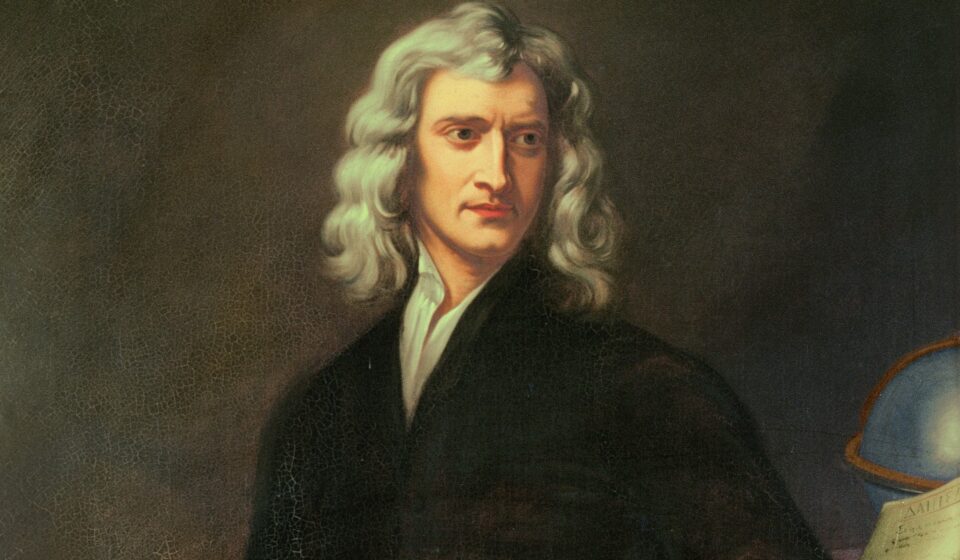
Isaac Newton is remembered as one of history’s greatest mathematicians and physicists. His work on gravity, motion and mathematics helped shape modern science.
But Newton had another side that is far less familiar.
He spent decades studying the Bible, religious prophecy and the meaning of biblical texts. Among his private writings was a calculation that has fascinated people for centuries: the year 2060.
This has led to a widely repeated claim that Isaac Newton predicted that the world would end in 2060.
But that isn’t quite what Newton wrote.
So, why did Isaac Newton think 2060 was important, and what did he actually expect to happen?
Did Isaac Newton Really Predict the End of the World in 2060?
Yes, Newton did write the year 2060 in connection with his interpretation of biblical prophecy. But describing this as a prediction that Earth would literally be destroyed in 2060 is misleading.
Newton’s surviving manuscript shows that he was calculating when a particular prophetic period would end. He connected this calculation to what he regarded as the decline or fall of a corrupt religious system and the beginning of a new era.
In one of his calculations, Newton wrote that a period of 1,260 years, beginning in AD 800, would end in AD 2060.
Importantly, Newton himself warned against treating such calculations as certain predictions of the exact time of the end. He wrote that he mentioned 2060 to discourage what he called the “rash conjectures” of people who repeatedly tried to predict the end.
So the popular statement that “Newton predicted the world would end in 2060” leaves out a crucial part of the story.
Why Was Isaac Newton Studying Biblical Prophecy?
Newton is often presented primarily as a scientist, but his interests were much broader.
The Newton Project, which publishes his surviving writings, notes that Newton produced extensive religious and theological writings alongside his scientific and mathematical work.
Newton believed that the Bible contained divine revelation and that its prophecies described events that would eventually happen in history.
He therefore tried to interpret biblical passages in much the same systematic way that he approached other subjects.
For Newton, understanding nature and understanding Scripture were not necessarily opposing activities. He believed both could reveal aspects of divine truth.
This is one reason the 2060 calculation is so interesting: it came not from Newton’s work on physics, but from his attempt to interpret biblical prophecy.
What Does 2060 Have to Do With the Bible?
The calculation is connected particularly to prophetic passages in the Book of Daniel and the Book of Revelation.
Newton studied several prophetic periods mentioned in these texts, including periods described as 1,260, 1,290, 1,335 and 2,300 days.
Newton followed a method used by some earlier interpreters in which prophetic “days” were understood as representing years.
The 1,260-day period was therefore interpreted as 1,260 years.
This is the key to understanding where 2060 came from.
How Did Isaac Newton Calculate the Year 2060?
Newton’s calculation was surprisingly simple.
It did not require the advanced mathematics for which he became famous.
Newton identified AD 800 as an important starting point in his interpretation of biblical prophecy. He associated this year with the beginning of the Pope’s supremacy.
He then added the prophetic period of 1,260 years:
800 + 1,260 = 2,060
That produced the year 2060.
According to the Newton scholar Stephen D. Snobelen, Newton connected the 1,260-year period with what he considered the period of corruption or apostasy of the Church. Newton therefore regarded 2060 as a possible point associated with the end of that period.
The 1,260-Year Prophetic Period
Newton’s calculation depended on his interpretation of a prophetic period of 1,260 days found in biblical prophecy.
He interpreted those prophetic days as years, producing a period of 1,260 years.
This interpretation was not something Newton invented from scratch. It was part of an established tradition of interpreting prophetic time periods.
Why AD 800 Was Important?
The year AD 800 was significant to Newton because of events involving the papacy and the political order of medieval Europe.
In that year, Charlemagne was crowned emperor in Rome by Pope Leo III.
Newton considered AD 800 an important date for the beginning of the period he was studying.
[H3] How 800 + 1,260 Became 2060
Once Newton selected AD 800 as the starting point and applied the 1,260-year period, the calculation was straightforward:
800 + 1,260 = 2060
This is the basic mathematical origin of the famous 2060 date.
Why Did Newton Choose AD 800?
The year 800 was significant to Newton because of events involving the papacy and the political order of medieval Europe.
Newton connected the year with the rise of papal power and the medieval religious order that he believed was represented in biblical prophecy.
However, Newton did not treat every part of his chronology as absolutely certain.
His writings show that he considered different possible starting dates during his lifetime. Earlier calculations pushed the possible endpoint to different years.
This is another reason the simplified version of the story — “Newton calculated the exact date of the apocalypse” — doesn’t accurately represent the complexity of his work.
What Did Newton Think Would Happen Around 2060?
This is where the story becomes much more interesting.
Newton did not envision 2060 simply as the moment when the planet would suddenly disappear.
Instead, he associated the end of the prophetic period with a major transformation in the religious and political order of the world.
According to the interpretation of Newton’s writings by historian of science Stephen Snobelen, Newton expected the fall of what he regarded as a corrupt Church system and the eventual establishment of a Kingdom of God on Earth.
In Newton’s theological framework, this would ultimately be a period of peace rather than simply destruction.
So, paradoxically, the year that is often described online as Newton’s “doomsday” was closer to a turning point or new beginning in Newton’s own interpretation.
Did Newton Believe 2060 Was Definitely Going to Happen?
Not exactly.
This is one of the most important details that gets lost when the story is retold online.
Newton was actually cautious about assigning exact dates to biblical prophecy.
In the manuscript containing the 2060 calculation, Newton explained that he was not asserting that this was definitively the time of the end. He presented the calculation partly to counter what he regarded as reckless attempts by others to set precise dates.
The Newton Project’s material also notes that Newton’s 2060 calculations were private writings rather than a public announcement intended to predict the future.
That makes the modern description of Newton as an “apocalypse predictor” considerably more complicated.
Why Did Newton Write Down 2060 If He Opposed Date-Setting?
This seems contradictory at first.
If Newton was skeptical of people trying to calculate the exact date of the end, why did he calculate 2060 himself?
The answer appears to lie in the distinction between exploring a possible interpretation and claiming absolute certainty.
Newton was deeply interested in biblical chronology. He wanted to understand how the prophetic periods in Scripture might fit into history.
But he also recognized the danger of presenting a human interpretation as certain knowledge of God’s timetable.
His 2060 calculation therefore appears to have been a private theological exercise rather than a public declaration that humanity should prepare for an exact doomsday.
Why Is Isaac Newton’s 2060 Prediction Trending Again?
The story has repeatedly resurfaced because it combines several things that naturally attract public attention:
- A famous historical figure
- A mysterious old manuscript
- A specific future date
- Biblical prophecy
- Mathematics
- The possibility of an apocalypse
The 2060 date first became a major international news story in 2003, when media coverage revealed Newton’s prophetic writings to a much wider audience.
Since then, the story has periodically returned to the internet and news media.
The Newton scholar Stephen Snobelen has documented multiple waves of renewed media interest in the 2060 calculation.
The modern version often becomes simplified into a dramatic headline:
“Isaac Newton predicted the world would end in 2060.”
But the historical story is more complicated.
Was Newton’s 2060 Calculation Based on Science?
No.
This is an important distinction.
Newton was one of the central figures in the development of modern physics and mathematics, but the 2060 calculation did not come from physics, astronomy or a scientific model.
It came from Newton’s interpretation of biblical prophecy.
His calculation was essentially chronological:
Biblical prophetic period → 1,260 years → chosen historical starting point → 2060
There was no astronomical calculation showing that Earth would be destroyed in that year.
There was no physical model predicting a planetary catastrophe.
And there was no scientific evidence suggesting that 2060 was a scientifically determined end date.
Did Newton’s Scientific Work and Religious Beliefs Contradict Each Other?
To a modern reader, they may seem difficult to reconcile.
Newton is associated with mathematical laws describing physical nature, while his private writings reveal extensive interest in theology, biblical prophecy and alchemy.
But Newton himself did not necessarily see these subjects as fundamentally contradictory.
The Newton Project explains that Newton’s interests extended far beyond the subjects for which he is best known today. His surviving papers include extensive scientific, mathematical, religious, alchemical and administrative writings.
In Newton’s intellectual world, studying nature and studying Scripture could both be attempts to understand God’s creation and intentions.
That makes his 2060 calculation less of a bizarre side story and more of a window into how Newton himself understood knowledge.
So, What Did Isaac Newton Actually Predict for 2060?
The simplest answer is:
Newton did not simply predict that Earth would be destroyed in 2060.
He calculated 2060 as a possible endpoint of a 1,260-year prophetic period that he connected to the history of the Church.
He believed this period could be associated with major apocalyptic events and ultimately with the establishment of a new era of divine rule and peace.
Most importantly, Newton himself cautioned against confidently claiming to know the exact timing of the end.
So when you see the headline “Isaac Newton predicted the world would end in 2060,” there is a real historical document behind the story — but the popular interpretation leaves out much of what Newton actually believed.
The Bigger Mystery Behind Newton’s 2060 Prediction
Perhaps the most surprising part of the story isn’t that Newton wrote down the year 2060.
It’s why he was trying to calculate such a date at all.
The same man who developed revolutionary ideas about gravity and motion also spent years trying to understand ancient biblical prophecies.
Newton wasn’t simply a scientist in the modern sense. He was a thinker whose interests crossed mathematics, physics, theology, chronology and alchemy.
And that is why the 2060 manuscript remains fascinating more than 300 years later.
The real question isn’t simply:
“Will the world end in 2060?”
It’s:
“Why did one of history’s greatest scientific thinkers believe biblical prophecy could reveal something about the future?”
That question tells us far more about Isaac Newton than the viral doomsday headline does.